19.2.2026
Ville Venäläinen
Agents within everyone’s reach – but when do you need a professional?
AI agents are now more accessible than ever. But ease of getting started does not mean you should – or need to – handle everything on your own. A few years ago, an AI agent was something only large corporations and tech giants could build. Today, the situation is different. With tools like ChatGPT and Copilot Studio, anyone can create their own “assistant” – at least in theory.
The ease of AI agents is real – and misleading
The apparent simplicity of AI creates hype and the illusion that everything is now possible independently. Reality sets in when you try to build something that genuinely works. Designing agents for real job roles requires expertise, and in practice they demand continuous maintenance. This is a powerful and versatile technology, but building services suitable for professional use requires skill.
AI is a bit like new software. Think about programming: the tools have been available to everyone for decades. Anyone can learn to code. But that does not mean every company should build its own software development team and develop everything in-house.
The same applies to AI agents. The first demo is easy – but then reality begins. The first version works, but what happens when something changes? What about new situations that were not originally anticipated? Experiments succeed, but a production-ready solution is another matter. Once a solution becomes part of everyday operations, it requires ongoing attention – not just initial enthusiasm.
A demo is not the same as a working solution
Research paints a sobering picture. Only a small proportion of AI initiatives generate significant business value, and the majority encounter challenges already at the implementation stage. The root cause is not the technology itself, but execution and what follows in daily use.
Typical pitfalls repeat themselves. The agent does not know when to escalate to a human. Planning and instructions are inadequate, leading the agent to hallucinate or provide incorrect answers. Change management is overlooked, and teams do not trust or use the agent. After the initial excitement fades, maintenance is easily neglected, and the solution quietly becomes outdated.
Experiment yourself, but rely on professionals for production use
Experimentation is valuable when the goal is learning and understanding possibilities. Simple use cases, a limited audience and non-critical processes are situations where building something yourself makes sense.
The situation changes when the agent is given a defined role. When it becomes responsible for part of a process, integrates with existing systems, handles customer data or operates in the customer interface. When there are hundreds or thousands of users and brand reputation is at stake, this is no longer experimentation but production use.
Integrations are a category of their own. When an agent is connected to CRM, ERP, customer registers or document management systems, it is not just a technical task. You must resolve how security, access rights and monitoring function – and how EU data protection and AI regulations are addressed. At this stage, “let’s try and see” is no longer sufficient.
Responsibility does not end at deployment
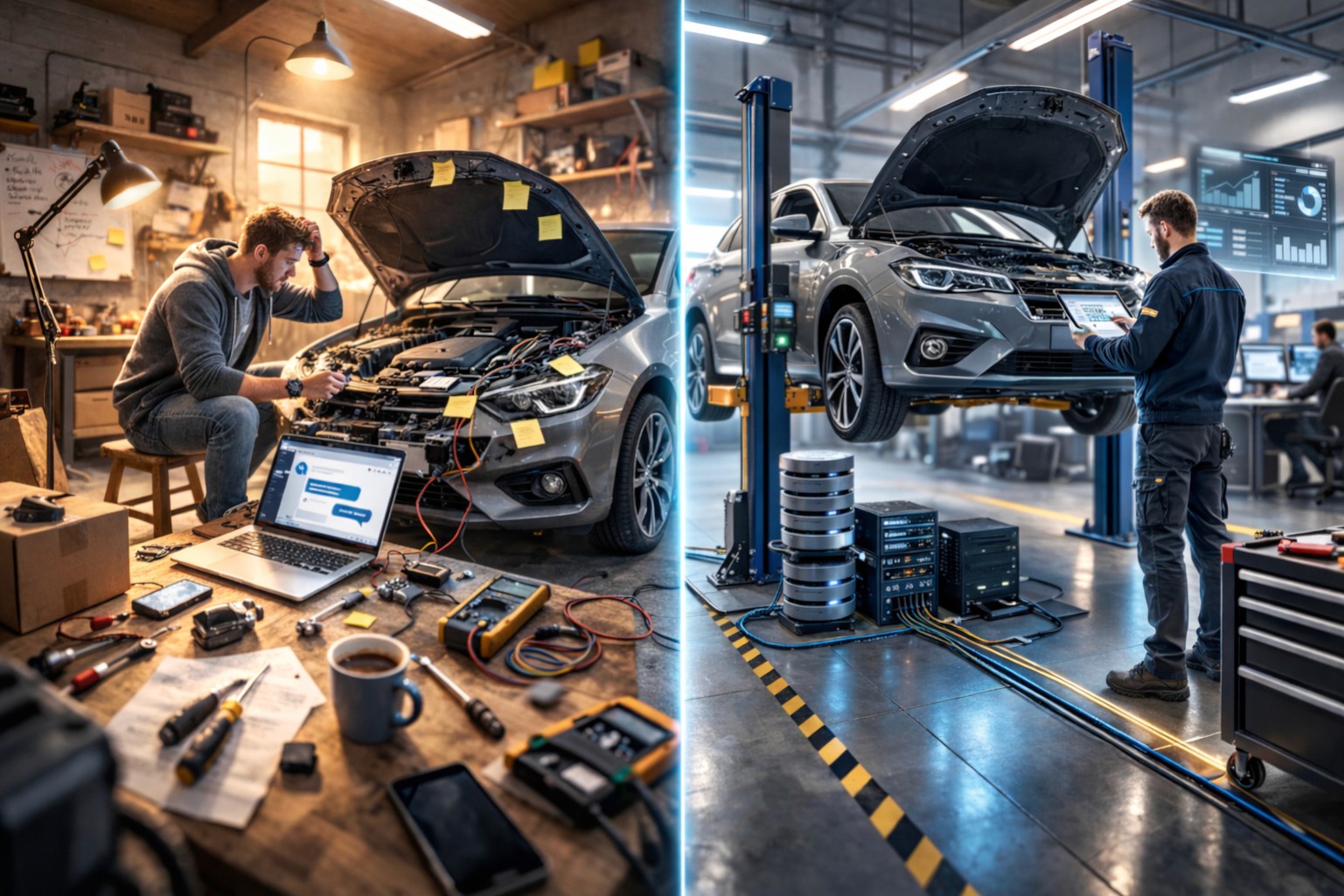
Anyone can tinker with a car in their garage in the evenings or build a house over the weekend using YouTube videos. The tools are available and enthusiasm is high. Yet work done by a professional is safer, more durable and longer-lasting – especially when something goes wrong.
The same applies to AI agents. Experimentation is valuable, but production use is different. A functioning agent requires continuous maintenance: backend systems are updated, users provide feedback, models evolve and errors occur. Someone reponds to these changes – or not.
At the same time, your core expertise and day-to-day work usually lie elsewhere. The essential question is not whether you can build the agent yourself, but whether it makes sense for your team to carry responsibility for its entire lifecycle.
In conclusion: experiment boldly, but know your limits
AI agents are a fantastic opportunity. Experimentation is inexpensive and learning is valuable. But once you move from experimentation to production, responsibility grows quickly. Ask yourself: who will maintain this in a year’s time? In three? What happens when the agent makes a mistake and its creator is on holiday?
Your own agent means your own responsibility. If that responsibility fits, excellent. If not, a partner is an investment – not a cost.
If you want a production-ready AI agent, take a look at our MAINIO.